Last week I had the pleasure of giving a guest lecture at the University of Bayreuth. Prof. Dr. Agnes Koschmider’s chair for Business Informatics and Process Analytics runs a lecture series on Generative AI this summer semester — covering everything from LLM fundamentals and prompt engineering to ethics, data protection, and regulation, with guest speakers adding real-world perspectives from industry and public institutions.
My part was the practitioner’s slot: a talk titled “Beyond the Vibe” — about how AI coding agents actually get used in day-to-day software development, beyond the hype and beyond, well, the vibes. 😉

The talk was in German, but the ideas aren’t — so this post is the English, personal version of it. Not a slide-by-slide transcript (the full deck is online if you want that), but the essence: how I approach AI coding, and why I believe context, verification, and infrastructure matter more than the model you pick.
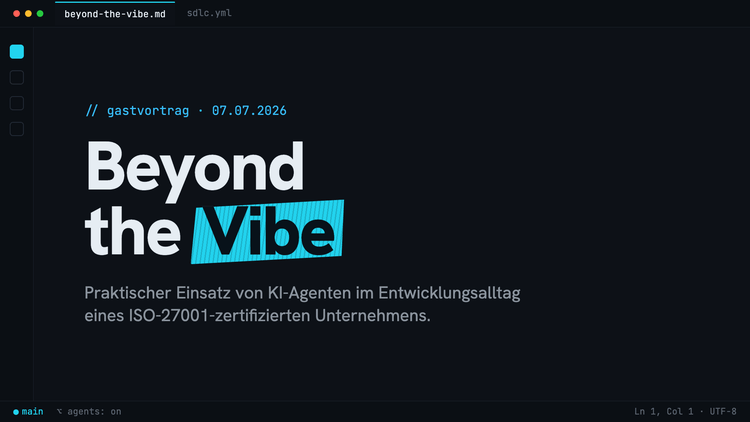
The title is a nod to Andrej Karpathy, who coined vibe coding in February 2025: “fully give in to the vibes, embrace exponentials, and forget that the code even exists.” A throwaway tweet that became the term of the year — and honestly, my own about page says “embrace the vibe,” so no judgment here. Vibing is where everyone starts — my first Claude Code post from March 2025 certainly did. This post is about what comes after.
Agents Inside an ISO-27001-Certified SDLC
First, where I’m coming from. I work as a senior software developer at an ISO/IEC 27001:2022-certified company: documented processes, traceable reviews, a secure development lifecycle. Real customers, production systems, audits.
And here’s the thing: agents get no special rules. They go through the same cycle as everyone else — plan, build, review, operate — with the same gates. Every merge request additionally passes through an AI review layer in our CI: a GPT-based reviewer that comments on risks, quality, and test coverage. It doesn’t replace the human reviewer; it’s an independent layer before them. The human decides.
When the external auditor looked at how we develop software, agents included, his verdict was:
State of the art — with an asterisk.
The asterisk wasn’t a caveat. It was praise — a process that goes above the standard. And it captures the insight that drives this whole post: agents work productively because of strict processes, not despite them. Good process and good agents amplify each other. That belief shapes everything below — even on this website, where the certification body is future-me. 😄
Context Is Queen (or King)
The lever isn’t the model — it’s what the agent can see. Same model, same prompt, wildly different results depending on the context. Models rarely hallucinate out of malice; they lack information: the current API signature, the project convention, the existing design, the reason behind an old decision.
The first context lives in the repo. A CLAUDE.md or AGENTS.md file carries the stack, the conventions, the commands — “this is how we build here.” It’s versioned, shared, and traceable (a nice echo of the ISO backdrop), and it grows with the project. This site has exactly that, with a small twist: AGENTS.md is a symlink to CLAUDE.md — one source of truth, two conventions, one harness-agnostic and one for Claude Code.
Plan first. For larger tasks I have the agent write a plan before it touches code. Assumptions become visible and correctable — much cheaper than throwing away a finished, wrong branch.
Beyond the repo, an agent gets context through three channels: its built-in tools (read, edit, search), Bash — the agent inherits my terminal, so every CLI I use becomes a tool — and MCP for external systems. Examples I actually use: context7 for current framework docs instead of stale training data, a GitLab MCP server at work, and design files via the Penpot MCP server.
Counterpoint: not everything needs an MCP server. Often the plain CLI is simpler and more robust — gh and glab cover most of what a Git-platform MCP does, and playwright-cli drives a real browser without any extra integration.
There’s a cost side too, and it’s easy to miss: every tool you connect writes its description into the system prompt before the agent has done anything. My favorite stat: Playwright as an MCP server ships 25+ tools and can burn ~114k tokens per test run; the slim CLI does the same job for ~27k. And more tools means more choices, which means less focus. The fix is lazy loading — tool schemas get pulled in only when they’re actually needed.
🔥 Hot Tip: Relevant context beats maximal context. Curating what an agent sees is worth more than connecting everything you can — curation beats full loadout.
The same lazy-loading idea powers skills: a folder with a SKILL.md that packages a way of working — review criteria, security checklists, project workflows. Only the one-line description sits in the prompt until the task actually matches. Best practices become reproducible and shareable instead of evaporating with the prompt that contained them.
Prompts Are Out, Loops Are In
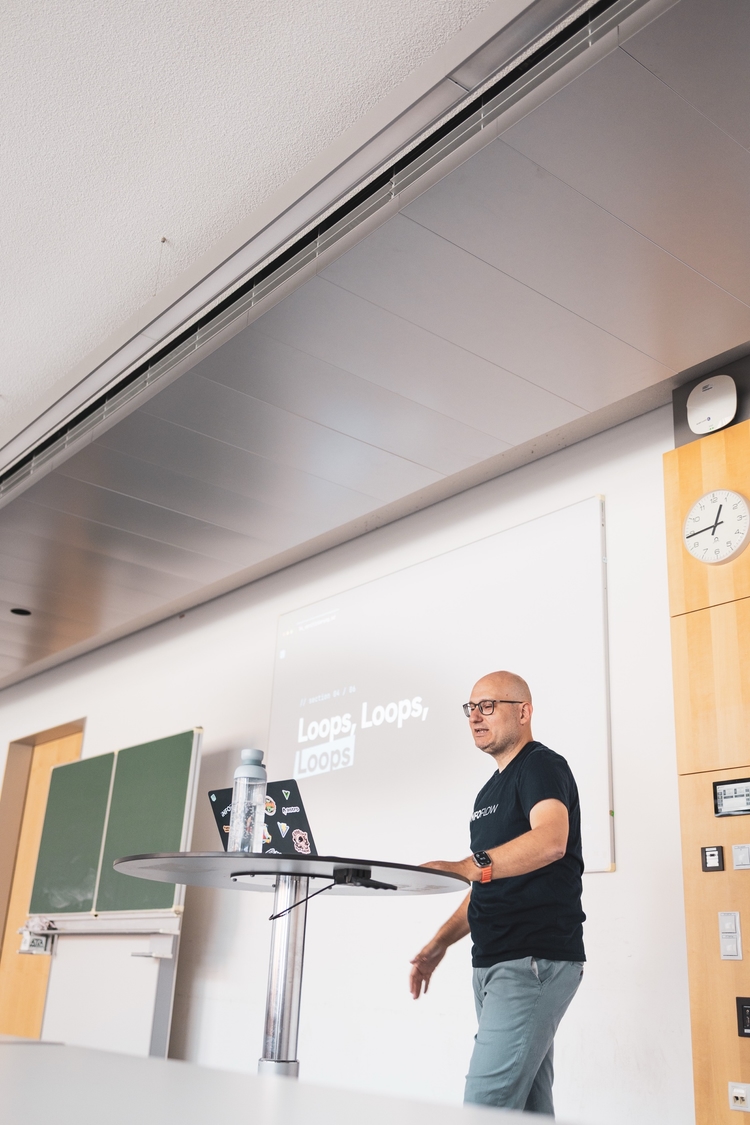
The unit of work isn’t the perfectly phrased prompt. It’s the loop: change → check → fix, repeated until green. Which leads to my favorite one-liner from the talk:
🔁 Remember: An agent is only as autonomous as its means of verifying its own results. Without checks, every iteration is blind.
Think of verification as a ladder, cheap to expensive. At the bottom: deterministic checks as loop fuel. Linters, typechecks, formatting, static analysis — cheap, fast, and deterministic, a clear red/green signal the agent can pull itself up on. A compiler error is a perfect teacher. On flori.dev that’s astro check, type-aware linting, and Prettier.
Next rung: tests as eyes. Unit tests are the tight, fast feedback path. End-to-end tests with Playwright go further — the agent drives a real browser, clicks through the flow, and observes whether it works. That’s the bridge from “the code looks right” to “the behavior is observably correct.” Small personal detail: this site’s dev server is agent-friendly — it auto-backgrounds itself with JSON logging (bun run dev:bg), so an agent can start it, test against it, and read the logs without blocking its own terminal.
Then: every change gets a URL. Vercel builds a preview deployment per branch, so the agent can check its own work against a real, running URL — and I decide based on real behavior instead of a diff. Great for non-technical folks on a project, too.
At the top of the ladder sits my favorite insight: adversarial review. An agent grading its own work is lenient; one told to refute it is honest. Different perspectives find different bugs, so a loop scales naturally into roles — implementer, reviewer, verifier. At work that’s cross-reviews plus the AI review layer in CI. At home it can be as simple as a second agent poking holes in the first one’s work.
One honest grounding note: loops need a stop condition, not babysitting. Goal-based (iterate until the Lighthouse score hits 90), interval-based (check open PRs and CI periodically), or event-triggered (a bug report, a dependency upgrade). And not every task needs a fancy loop — start with the simplest thing that works.
Infrastructure Decides Whether It Scales
One story made the audience sit up more than any other. The numbers are a snapshot as of mid-2026 — they age fast.
Bun. The JavaScript runtime was ported from Zig to Rust — roughly a million lines across 6,755 commits — in six days, with 99.8% of the test suite passing, via orchestrated agent workflows. The whole thing is public in PR #30412, merged May 14, 2026 — and the Bun team has since published a detailed write-up, “Rewriting Bun in Rust”, on how they pulled it off. Honest footnote: automated review still surfaced 78+ issues, and the PR was explicitly not release-ready. Loops do the heavy lifting; humans still decide.
What made that possible wasn’t a smarter model — it was the platform around it: a massive test suite as the verification signal, orchestrated workflows, and infrastructure that could run thousands of loops in parallel.
The personal translation: this is why the ISO processes from the beginning turned out to be an asset — and why even my personal website has CI, preview deploys, tests, and repo-level context files. Same investment, hobby scale. The “state of the art — with an asterisk” processes weren’t in the way. They were the head start.
Where This Is Heading
If I look ahead, the loop is already leaving the terminal. Agents run asynchronously in the background, coupled to CI — reading errors, fixing code, re-running the suite until it’s green. To be clear, they’re not magical daemons: they run through configured integrations and event triggers, kicked off from Slack or Git, not out of thin air. But when a million lines can be ported in six days, the lesson is the same one the auditor’s asterisk taught me: the model was never the bottleneck. The platform was.
That’s why I’m convinced the job of a software engineer isn’t shrinking — it’s shifting. Less typing lines, more designing the systems agents work in: the context they see, the loops that verify them, the infrastructure that scales them. Depth stays valuable; breadth just became affordable — even for small teams, even for one person and their website.
If you take three things away from this post, make it these:
- Context decides whether agents work sensibly.
- Verification decides whether results hold up.
- Infrastructure decides whether it scales.
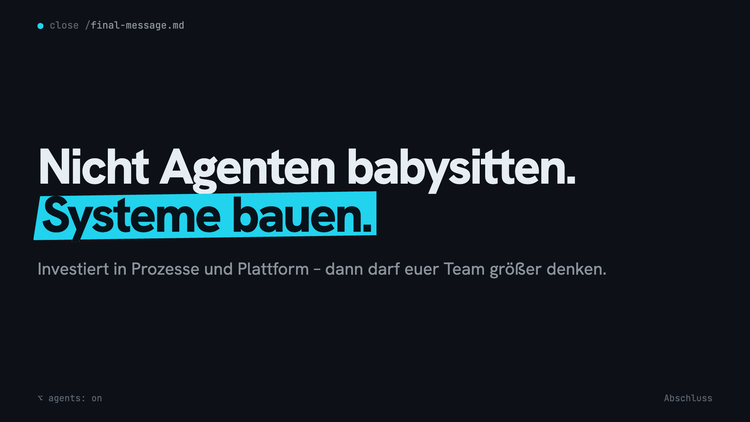
Or, as I put it on the last slide: don’t babysit agents — build systems. And then allow yourself to think bigger. 🚀